Sunday, February 27, 2011

Role Models

Forget American Idol (although I am somewhat following it!), today I want to talk "Academic Idol"!

Yes, I'm a nerd. I spent two days last week at a workshop for Native youth (all women and girls) on "Values and Ethics in the Aboriginal Workplace." In addition to the usual where you're from, what you study, where you work, etc. in our round of introductions we were asked to name someone we look to as a role model.

Many mothers, grandmothers and great-grandmothers we named, as were Elijah Harper, Metis artist Jaime Koebel, and even a few politicians (no one from within the workplace, ironically).

When the line rolled around to me, I could feel my breath start to shorten a little. It seems no matter how many times I speak in front of a crowd, I always have at least a tinge of anxiety.

"My name is Mallory Whiteduck, I'm from Kitigan Zibi and I work at the university," I started, "and I'm having a hard time narrowing it down to just one role model. I guess I should consider myself lucky in that way."

I went on to explain how I admired my younger brother as someone who has strong values and a solid ethical foundation. But in reality, I have so many role models. I draw from numerous different people as I try to live a good life. My mom, my grandmothers and grandfathers, R.J., cousins, friends, my director, co-workers...!

But in the world of Native American literary theory (told you I was a nerd) and the scholarly Native world in general, Lisa Brooks is my academic idol.

[Rewind to Christmas Eve]

R.J. and I sit in his car after leaving my aunt's house, and he hands me a poorly wrapped present. I smile. I wasn't expecting much considering he's taken a year to return to academia. I excitedly tear it open to reveal Lisa Brooks's The Common Pot: The Recovery of Native Space in the Northeast.
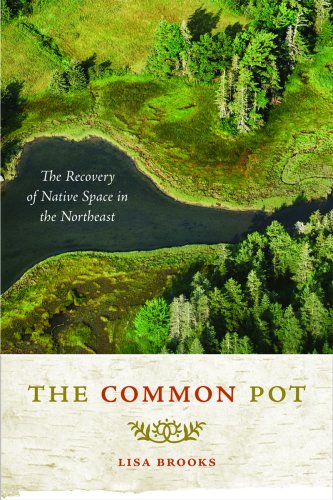

Inside the book was a note that said he had emailed Lisa Brooks to invite her to a lunch with me in Boston (she's at Harvard) paid by him. I grinned form ear to ear at the thoughtfulness of the gift.

"She hasn't emailed back yet," he went on to explain. "But I only sent it a few days ago."

The holidays crept by without any updates. I was almost afraid to ask for any because I knew the answer would be no, she hasn't yet responded.

She's a Harvard professor, I rationalized, entering into self-preservation mode. I'm sure she doesn't have time for a lunch with some random "fan."

But after we came back home, got back to work and returned to some semblance of post-holiday reality, a message popped up in my inbox with the subject line "FWD: Inspirational Student for Christmas." R.J. had forwarded a response from Lisa Brooks where she not only happily accepted the invitation to lunch, but offered to set up a tour of Harvard's Native American Program and even invited us to share a meal with her husband and daughter at their home outside of Boston.

We returned from the trip on February 20 (my birthday!) and I'm still reeling with energy, excitement and inspiration.

Saturday, February 5, 2011

Colonization. There, I said it.

Colonization is probably one of the most loaded words in Canada.

I think it makes Canadians uncomfortable. Actually - let me try that again. It makes Canadians who who understand the true history of this country uncomfortable. Which, arguably, is probably a smaller percentage of Canadians. Most think colonization is a thing of the past, reinforced by "post-colonial theory" and lack of use of the term in popular culture.

But, Canada's history of colonization makes some Canadians uncomfortable because it demands that they come to terms with the genocide and various other levels of atrocities wrought against our people by their Canadian/European ancestors. And people can get pretty fired up about their ancestors. I remember two friends in high school whose friendship quickly ended after an argument over what "her ancestors did to my ancestors" - and they were both of European descent.

But wait - what about those Canadians who don't connect with their ancestors? In other words, the Canadians who don't realize that they may have had the same values and beliefs that necessitate(d) colonization that their ancestors did, and instead distance themselves from family who didn't walk to earth in their lifetime. I would venture to guess that those Canadians think this comic is racist towards Canadians:

(I got this here)

And yes, those Canadians are out there.

But of course, I can't leave out the number of Canadians who would find this comic hilarious. Those Canadians are the allies. The ones who understand Canada's history of colonization, but it doesn't make them uncomfortable. Rather, they feel the the impulse to attend rallies for Indigenous rights, major in "Aboriginal Studies" and sometimes even dedicate their lives to educating their fellow Canadians about colonization.

---

I didn't begin this post to try classify Canadians into various groups related to how they feel about colonization. But I believe that everything happens for a reason, so there you have it.

I meant to talk about my feelings about colonization. (For now at least, because it changes, and I think that's a good thing.)

I never gave much thought to colonization until, well, around 2007 when I started my M.A. I mean, before that I knew about the devastating impacts that residential schools have had on our people and I witnessed some of those effects first hand, but I never named it as 'colonization' or thought about the intersectionality of all of the issues in our communities.

After I was able to put the term 'colonization' to all of this, I felt *so* empowered. I threw the term around in essays and in speaking to friends at pubs. (I didn't so much throw it in the face of Canadians - despite my above 'manifesto' on Canadians and colonization, I actually have a pretty non-confrontational nature and it takes a lot for me to tell people things I know they don't want to hear.)

But then something changed.

Yesterday, on my drive to work, I tuned in to CBC Radio in the middle of an interview with someone who works in security for the City of Ottawa. It sounded as though he was travelling to a "third world" country to do "humanitarian" aid.

"How do you think you'll experience culture shock?" the interviewer asked.

"Well, due to the effects of colonialism," the dude began, ''the people have become very formal. They address each other using 'Mr.' and 'Mrs.' and wear full suits to work."

In my experience, the purpose of discussing colonization is to provide context. But with little to no context in his statement, I found the evocation of colonization to remove the self-determination of the people - whoever they were he spoke of.

So, my question is: when does a so-called effect of colonization, in this example the dress or fashion of a people, belong to the people?

Thursday, February 3, 2011

Just do it.

I am going to take a moment and gush unapologetically about my amazing boyfriend, best friend and partner in crime, R.J.

He is great for so many reasons, but one of the things I love most about him, and about our relationship, is his ability to hold a conversation. Actually, the word "hold" is a bit lackluster. He respects, engages and challenges me in our conversations.

Our beliefs are relatively different. He hangs out a little left of centre, meanwhile I'm so far left I can almost touch the edge. (Although assuming there is a cliff at the end is kind of inferring that it's not good, but I'm digressing.) Regardless of our differences of opinion on issues like, say, capitalism, one thing we can always agree on is that we both see a better future for our people (he is Ojibway/Potiwatomi/Chippawa).

We work at the same location (and live together, and no, it's not too much) and some of our best conversations are had on our drives to and from work. While some I would rather forget - one in particular about the Oksana Grigorieva/Mel Gibson nightmare - others leave me with a feeling of absolute bliss.

Cut to today.

We were talking about projects. We shot back and forth about his school work and volunteering, and my work and potential opportunities. I work in Native student recruitment and we often muse about what Aboriginal youth "need" to be able to see themselves at a post-secondary institution.

"We should start a project," R.J. proclaimed.

I felt my heart immediately start to race. I wasn't quite sure where this was going, but I knew I liked it.

"We talk so often about what needs to be done," he continued, "so why don't we actually make something happen?"

What resulted was three or four ideas thrown back and forth about what we could do (until we settled on one), what it would be called and what the objective would be. We're not nearly ready to go public with anything yet, and in actuality our conversation probably totaled about 30 minutes over the evening, but I can't help but feel like we're on the precipice of something big.

Thursday, January 6, 2011

One-Minute Book Review: Through Black Spruce


Through Black Spruce (Joseph Boyden)

There were a number of times I picked up and read the back cover of this book at Chapters, only to place it back on the shelves. While I always enjoy a story that I can relate to, I also appreciate certain degree of escapism and distance between myself and a novel's content. In this book the two main characters' story lines hit close to home: Will Bird, the former bush pilot, reminded me of ni-awema (my brother) who got his wings last summer, and Annie Bird's sister, Suzanne, who is missing, recalled the work I did as a researcher for an initiative that related to missing and murdered Native women and girls.

At a buy three, get one free sale at Chapters, I could no longer find reasons not to buy it. After reading the first chapter, I could no longer understand why I waited so long. I missed the Bird family, whom I'd first met in Three Day Road, and all of their habits and insights.

I was particularly drawn to the story of Annie's search for her sister, Suzanne, and her travels 'through black spruce' to the cityscapes of Toronto and New York City, and back home again. I could relate to her perspective as a girl from the rez who became intoxicated by life in the city and all of the cheap thrills it has to offer.

It goes without saying for anyone who's read Boyden or even heard of him that the writing in this book is beautiful. I've already purchased my copy of his third book, Louis Riel and Gabriel Dumont, which is part of Penguin's Extraordinary Canadians Series.

Monday, November 29, 2010

To End a Perfect Sunday, or My Turn to Organic

Yesterday my day ended with some - how shall I put this? - trauma.

Let me preface this by saying I had a wonderful Sunday. One of those Sundays that is so relaxing you wish you could have another on Monday. My Sunday included waking up to my boyfriend, R.J.'s, omellete with green peppers, mushrooms, onions, ham and mozzarella cheese; doing my nails in sparkly hot pink while catching bits of Micheal Moore's 'Capitalism: A Love Story' and flipping through People magazine; a run on my treadmill; and dinner at my parents'.

When I returned home to my apartment after a rez-style dinner (hamburger la sauce padakan), I read the first 15 pages of a new book (Love in the Time of Cholera) and chatted with my friend, Katie, whose wedding reception I'll be attending in the Dominican Republic next week (eeek!!!). As it neared 10 o'clock, I wondered, should I go to bed and continue to read or see if anything is on T.V.? Not surprisingly, the television won. (Sidenote: one of the resolves I made this weekend was to temper my horrible T.V. habit - and I mean horrible as I count myself among those addicted to reality garbage - with more reading, music and doing things with my hands.)

Just check the usual stations and go to bed if nothing's on, I told myself. I flipped through the first few channels and found that 'Food, Inc.', a documentary I knew to be abuzz, was on CBC's 'The Passionate Eye.'


Perfect, I thought, pleased that my T.V. time this Sunday evening promised to be educational.

Then came the trauma.

For anyone who hasn't heard of 'Food, Inc.', it's an Academy Award-nominated documentary about the fast food and supermarket industries and what they have done to farming in the U.S. It combines things like state conspiracy, a tragic story of a two-year-old who died from e-coli and stomach-turning slaughterhouse scenes.

Not necessarily the kind of way you want to end a perfect Sunday.

Nonetheless, I am so glad I watched it. It was truly an eye opener for me. Sure, I knew the statement "grass-fed beef is good for you" to be true, but I never really understood the meaning behind it. (In other words, I had no clue whether cows were supposed to be eating grass, corn or hay!) I had heard others reference how sickly and poorly kept KFC chickens are, but I'd never seen any video or read any article for myself.

Now I am concerned about the food I eat and, simply enough, I want to know what goes into it. I am concerned for my heath and R.J.'s, the health of the family we will someday have and the state of the western world's reliance on corporate meat. A viel has been lifted and I can't go on eating whatever food is quick, easy and time-saving (as I learned when I found myself picking pieces of chicken out of my microwavable BBQ chicken and rice "meal").

I am going to start (and this is a huge leap for me) by not eating beef unless it's grass-fed or chicken unless it's grain-fed. I am also going to buy more organic and check out Ottawa's Organic Farmer's Market, open year-round on Saturdays. And, possibly most importantly, I am going to have to stop being lazy and get cooking!

As Anishinabekwe, I am hoping that our ancestors' connection to the food we ate will have a stronger pull than the inevitable supermarket/fast food attempts to win back my loyalty.

Stay tuned...

Tuesday, November 9, 2010

"As Algonquin people, it's our time"

There is a traffic slow down today in my community, Kitigan Zibi Anishinabeg, to raise awareness about First Nations education, particularly our right to post-secondary student support.

Did anyone know that? My guess is no.

My community is doing such amazing things these days, including being behind the First Nations Education Week & Rally in September, but I didn't see or hear much about the slow down in national or local news outlets. The closest I came to seeing exposure for K.Z.'s slow down was in an article about the slow down on the highway 17 near Garden River First Nation (the other kitchi sibi, funnily enough)/Sault Ste. Marie. I was happy to see that there was an article in the Toronto Sun, but slightly depressed to read the last line: "The Kitigan Zibi Anishinabeg First Nation in Quebec is also planning a slowdown Tuesday on the same issues."

My Dad is attending this slow down. When I went to my parents' house (in the city) for Sunday dinner and he mentioned it, I asked, "Did they issue a media advisory for it? What's the point in doing something to raise awareness if you don't get the word out?" (Obviously, I made an assumption between the first and second questions.)

"I don't know," my Dad replied, each word its own sentence. "Last year they contracted a white guy to do that stuff."

I do my best to stay out of rez politics. Of course, like anyone else, I enjoy hearing the latest goss, particularly around election time. But I don't find the need to scrutinize every decision that comes out of the band office.

As I returned home to my apartment after dinner, I found myself drifting off into a fantasy about doing freelance communications work for my band. It wouldn't be that difficult to put together a contact list of local media persons who have interest in these things and throw together a media advisory for distribution. Hell, my friend Howard is doing archival research for his band for free.

I have to do more. Something is compelling me to. I may not be good at a lot of things, but with a B.A. in communications, certainly I can help in this little way? I want the world to know about my cousin Bee's thoughts and what it means for it to be our time as Algonquin people. I want them to know that in our community it is a big deal that we unveiled this awesome billboard shaming the government. I want them to know what it means when we say we have a right to education.


I WANT TO SHOUT IT OFF ROOFTOPS! And, unfortunately, my blog just isn't quite loud enough.

Thursday, October 7, 2010

The Plastics

I've never been an Elder's Helper.

Two Elders, Sally Webster and Thomas Louttit, made opening statements and prayers at the opening of a new annual lectureship, featuring the amazing Inuk leader Mary Simon, at the university where I work. I happily accepted the (last minute) request to be an Elder's Helper for Sally at this event.

I'd brought a bottle of water for each of the Elders - just in case. Sally arrived with a young Inuk communications officer named Melissa, and both of them were parched. I admit, I felt pleased with myself that I'd made this call - so far, I was receiving a passing grade as an Elder's Helper.

Not too long afterward, Thomas Louttit arrived with his Elder's Helper (a university student). After a couple of minutes had passed and Thomas seemed to garner that I was at the event in some sort of official capacity, he asked if we had any water. I immediately became flustered - I'd just given the only two bottles away! Luckily (or so I thought), my office was only a floor below and I ran down to grab a bottle of water from the case I had leftover from our pow wow a couple of weeks earlier.

I approached Thomas with the bottle. He took it, looked at it, and asked, "What do you think of these?" Before I could respond - and maybe this was where my luck played a part, because I had no idea how to reply - the event organizer approached with glass of water. "Ah, I'll take this," he said with a smile, putting the unopened water bottle down on table behind him. He was quickly engaged in another conversation, so I returned to Sally. (Elder's Helper fail.)

"Are you the official organization photographer?" I ask Melissa, the communications officer who arrived with Sally, in my usual semi-awkward way.

"Photographer-in-training," she answers with 'smeyes' (yes, I just quoted Tyra Banks). "This was my first assignment," she says and shows me a photo of a plastic spoon on the tiny digital camera screen.


She then proceeded to tell me this beautiful story, which I will do my best to re-tell:

An Inuk storyteller tells about his first encounter with southerners. When he was a young boy, he and his friend spotted some white men who had set up a camp. They were too shy to approach them, so day after day they watched them from afar. When the men had finally packed up and left, the two boys went to their camp to see what they could find. There were empty tin cans and other stuff laying around. The boy picked up a plastic spoon and brought it home. When his mother saw it, she made him clean it and take care of it well. Finally, one day it broke and his mother got so mad! Now, whenever he travels he always packs a plastic spoon in his suitcase.

The three of us laughed at the story and proceeded to wonder what it could mean. Melissa thought the spoon would remind him of his mother. I thought it was interesting how he took such good care of his spoon, yet today in the 'south' plastic utensils are made for one time use.

After the lecture I headed over to the opening of "Haida: Life. Spirit. Art." at the Museum of Civilization.


The exhibit was great - no plastic, but wood, bent box, mountain goat horn, stone and other natural materials. Many of them date back to the 17th century. What made this evening truly amazing was the chance to hear from and be in the presence of Haida power couple Robert Davidson (living legend artist and carver) and Terri-Lynn Williams-Davidson (lawyer on the Haida title case). I hit up the gift shop afterward and in my own attempt to be less wasteful, I bought this awesome hummingbird mug:


Thomas Louttit's question, the story Sally shared, and the Haida experience together worked to remind me, as much as I love pop culture, not to turn into... (and this pains me a little to say because I love Tina Fey so)... The Plastics!