Wednesday, March 29, 2017

leaning into affect

I am a Pisces. I am an INFJ. My true colours are blue and green. My top Strengthsfinder result is intellection. I'm Ravenclaw.

If you're into personality tests, horoscopes and other narcissistic self-awareness tools that help you learn about your inner-self, then you might recognize the commonality among my results: Emotions. Feelings. Thoughts. Dreams.

My first year of grad school has felt like running a marathon interspersed with some intense sprints to get to the finish line in good time. On the first day of my spring break, I crashed into a brick wall. Levelled with my third (third!) cold of the school year, I was forced into several days of rest. I saw that the movie Twilight had been released on Netflix, so I watched it one evening. I'd seen the movies before and tried to read books, but gave up in a pretentious coo against the poor writing and ableist language. I hadn't even gotten to the imagery of Indians yet.

With the perfect combination of fatigue, stress and self-indulgence, and with a virus coursing though my blood (ha), I was primed for a fling with this terribleamazing series. The next day, I laid on the couch and watched New Moon, Eclipse and Breaking Dawn (both parts) in rapid succession. Rod got home just in time to catch the battle scene.

"I want to watch it all over again," I said. He laughed. I wasn't joking.

I went to bed, waiting for the feeling to pass and hoped to wake up the next morning compelled toward the history and literature I was supposed to be reading during the break. Instead, I woke up and downloaded the first Twilight book, problematic as it is, on my Kindle. Hours passed in minutes and I was reminded of the joy of devouring a book, of any kind and at any place, as a kid.

Then, something even more unexpected happened: I got on my computer and opened up the 25 page file of a novel I had been working on. It's a YA novel. I worked on it in six month intervals, writing about 5 pages in each sitting; you can do the math to see how long this project has been in the making.


This unexpected Twilight obsession, while it felt like my own personal shame, had awakened within me the inclination to write with joy. To write not caring about so many of the things that kept the Word file locked up on my drive for 11 months of the year. I let go my worries about writing well and writing something important. I just wrote. And this letting go has had me coming back to the file more often that I ever have in the past.

After a few days carrying on like this, I started to reflect on the change. My illness over the break made me too weak to care about what others might think about my Twilight-a-thon. I momentarily shed the societal norms that exalt extroversion and condemn the emotional, the thoughtful, the feminine, the quiet. And instead, I leaned into my own affect. I think I'll stay awhile.


nayyirah.waheed

Friday, October 28, 2016

Those Illusive Characters (Time and Balance) in the Life of a Grad Student

It's Friday morning and I'm drinking coffee. I don't have class on Fridays. I am sitting on my new couch, a comfortable reclining love seat where I spend about 40% of my time. "Farmhouse Rules" (a Food Network TV show) is playing in the background as I jump from tab-to-tab on my laptop: from Twitter, to updating my Goodreads account to include my PhD reading list, to the public library website, to my grant and conference applications, and now to writing this post.

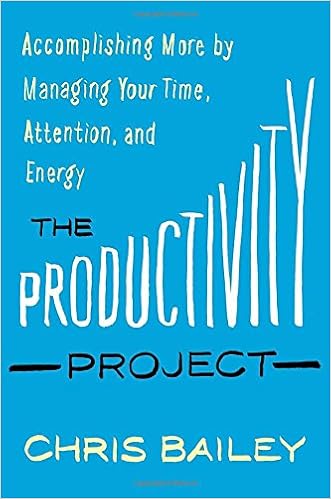
Image result for the productivity project

Before starting my PhD program in September, I read The Productivity Project by Chris Bailey. One of the takeaways from that book was the "Rule of 3." He recommends writing down a daily to-do list containing 3 items. It's a technique that is meant to keep you focused on your priorities for the day. I do it every day in my bullet journal, and I end up with something that looks like this:


(There are so many beautiful, artistic bullet journals. Mine is all business. Journalling artistically is something I admire, but it's not my strength.)

But most days, I end up with way more than 3 things to do:

Rule of 3
  • History readings
  • Exercise (run or yoga)
  • Draft conference proposal
but also...
  • Groceries
  • American Studies readings
  • Tidy apartment
  • Pedagogical exercise
  • Email
I've heard from so many graduate students and academics how hard it is to manage time and maintain a balance in their lives. Perhaps naively or optimistically, I thought that returning to graduate school after 8 years in the work force would play to my advantage: if I maintain my 9-to-5 foundation, doing school work during those hours, I could use my evenings and weekends to spend time doing my favourite life things, like reading, yoga, watching TV, healthy cooking and meal prepping, and time with family and friends.

Simple, right? Unsurprisingly, it didn't turn out to be quite that easy. 

Another lesson from The Productivity Project was the role your brain plays in all this. From what I remember, there are basically two parts of your brain that control your motivation: prefrontal cortex and limbic system (something like that). The prefrontal cortex is where your brain processes complex and difficult tasks (e.g. reading academic texts and writing assignments) and your limbic system is the feeder for procrastination, where you passively absorb fun things (e.g. a Netflix binge or, in my case, an inexplicable new addiction to YouTube makeup channels that coincides with the first year of PhD studies). 

The more you exercise your prefrontal cortex, the easier it is to get cracking on the productive things you know you should do and, in many cases, really want to do to keep your life together. Because it's so easy to feed your limbic system and you get a little buzz from doing so, it is often the stronger muscle.

Thankfully, the act of writing this post pulled me out of my Friday morning limbic activity. I've worked my prefrontal cortex by flexing my writing muscle and producing something. 

So, as it turns out, I'm not some kind of Time-Balance Grad Student Superwoman. And that's okay. Like many before me, I am struggling with self-discipline and managing open expanses of time.

I am committed to winning this time/balance battle, starting by doing something many grad students would think is bananas: Reading a book for fun.

To be continued...

Tuesday, February 2, 2016

Anishinabe Scattergories

The first time I realized that the answer to a question didn't have to be obvious was in grade two. My teacher, Freeda, asked: "What is your favourite season?"

Each student had the chance to answer and a chorus of "Summer!" rang through the classroom. One of the kids responded, "Winter" and was met with looks of horror or disgust.

"My favourite part of the year is the change in seasons," said Freeda. "I love it when the first snow falls and then thaws to reveal fresh plants and flowers. It's a beautiful cycle and we get to witness it again and again."

Intrigued by how the answer stood outside of the standard responses us seven-year-olds could think up, I tried to employ this new technique later in Algonquin language class. We were playing a handmade board game, basically an Anishinabe version of Scattergories.

The teacher read from a list of categories and we had to silently write down our responses on a piece of paper, hoping that no other student would have the same answer and leave us both pointless.

Of course, we all knew there were four colours in the medicine wheel: white, yellow, red and black. But I remembered my grandmother explaining to me why she always hung a purple ribbon on her medicine wheels: "Purple is a very sacred, spiritual colour," she explained.

When the time came to read our responses and count up the points for each unique answer, I proudly responded, "Purple!" to the medicine wheel question, convinced that I had bested them all.

"There's no purple in the medicine wheel," said my teacher. "Wrong." I began to protest, but she was already moving on to the next kid.

Much to my dismay, my constant companion and competitor in class was the only student to answer white and received one point.

Monday, December 14, 2015

The Privilege of Being a Rez Bookworm


The highlight of my life as a ten year old was when the Scholastic Book Fair came to town the rez. I can still remember the anticipation of its arrival (second only to the anticipation of receiving a Scholastic Book Order), begging my parents for as much shopping money as they would give, and seeing the poster boards up around the school, the date written in black permanent marker.


When the Book Fair arrived, our teacher lined us up and paraded us over to the high school section of the school where the fair was set up. I pored over the books for as long as they let us browse--not nearly long enough, as far as I was concerned. I loved the swaths of books of all genres set up in tidy piles across numerous tables. The books were colourful, shiny, and new. Just waiting to be devoured on the couch that Saturday. I would purchase one book from a favourite series like Sweet Valley High or Goosebumps, and save the rest of my money for when I could return at lunch and recess and browse without the pressure of returning to class. In this uninterrupted time I would carefully consider and select however many books I could afford, sure to spend any spare change on a bookmark or two.

I would move through the rest of the day thinking of nothing but the books in my bag, finding any opportunity I could to set them out and just look at them or swap titles with my fellow book nerd BFF.

My love of books was enshrined.

---

A few weeks ago, I returned to my old school on the rez, the one with the book fairs. I was attending an event in the school library and I was hit with a dose of nostalgia seeing a poster for an upcoming Scholastic Book Fair in the hallway.


I walked into the library and it felt so small. It was set up exactly the same as it had been when I was a kid: a magazine corner next to the check out counter; a couple of computers along the wall; and four short stacks of books at the back, with a children's section at the far end.

Granted, I was small the last time I had spent any significant time in this library. And before I'd had the chance to grow up, come-of-age, and maybe explore those library stacks beyond the children's section, I moved. To the city.

And that's when I realized I'd been living in a Book Desert.


It was when my mom took me to the Chapters bookstore in downtown Ottawa. I'd heard about it from one of my new teachers in junior high (a novelty to me, since no junior high existed on the rez but I'd seen it "glamourized" on Degrassi), who told us of this massive bookstore that had two floors! And sure enough right in the middle of the store was an escalator that moved me up to the children's and teen sections where I could spend hours.

How had I gone so long without knowing a place like this existed?

Did these city people realize how lucky they were to be able to buy any book they wanted just outside their front door?

Mom, when can we come here again?

---

On the reserve today, there is still hardly a place to browse and shop for books. In fact, I can't think of one.

My boyfriend's reserve is next to a slightly larger town than mine, so kids and people there could buy books at Wal-Mart. But have you seen a Wal-Mart book section? Sure, it has some bestsellers and, arguably, a true book nerd would make it work--but how can you inspire a love of reading in children with such limited book resources?

Although I've taken to public libraries this year, to this day one of my favourite hobbies is still browsing in bookstores, both small independent ones and massive chains (I have no shame).

The truth of the matter is that to be a bookworm on the reserve is a true privilege.

Monday, July 1, 2013

A Canada Worth Celebrating


Kanata by Greg Hill

Tomorrow I'm meeting with people from a university in England and I have the pleasure of explaining to them why my office (an Aboriginal resource centre at a university) exists. Today being Canada Day and all, I got to thinking: What would be a Canada worth celebrating?

Some obvious things come to mind: honour the treaties, stop the Keystone XL pipeline (and other environmentally violent projects), treat Indigenous women with respect, recognize our nationhood.

Tomorrow, I will tell the Brits about why our office exists. It is because colonization is a fact in this country. I will use the example of residential schools as one of its most violent forms (but I won't fail to mention the theft of land, and the destruction of the role of women and governance traditions). And I will explain the way this assault on Indigenous peoples has created a plethora of socioeconomic issues that plague our beautiful women, men, children, elders, and communities.

Will it be a lot for them to learn in 5 minutes? Probably. Will they understand it upon reflection? I hope so. Will it shatter what they think they know about "Indians"? That's certainly what I'm going for.

On Friday I was talking to other activists about hope - Indigenous rights advocates, feminists, and proponents of diversity. We wondered, like all activists do at some point, if the work we are doing is any different than it was 30, 40 years ago. More importantly, is the world better off?

"Should we lower our expectations?" questioned a woman who's been in the field for over 30 years.

To me, the answer is obvious: No. I have absolutely high expectations of Canadians, and the role they must play in decolonization and reconciliation. And I don't plan on lowering them one bit. I also have hope that it's possible, because the majority of Canadians are loving and compassionate people.

This is why my office at the university exists: it is a responsibility. Canada wanted to eliminate so much of what makes our nations great through the residential school system. Apparently, 5 years ago, Canada realized what they did was wrong and issued an apology. Today, all school systems in this country have the responsibility to make space for Indigenous ways of knowing to be reclaimed and to grow and flourish.

When Canadians take the time to understand this history, to assume their responsibility, to respect our nationhood alongside their own, and to take tangible action to decolonize Canada, I will stand with you and say:

Happy Canada Day.

Tuesday, June 4, 2013

An Activist Nap

A tiny glimpse into my personal life: I am a napper. Last night, after work, I napped from 5-7 p.m. (Could have something to do with the fact that I'm an on-and-off anemic, but that's besides the point.) After a nap like this, I wake up feeling one of two ways: 1) refreshed and ready to be productive for the final few evening hours, or 2) "WHAT?!? It's 7! How am I going to cook, clean, watch my favourite show, work out, and get to bed at a decent hour? Why do I do this to myself!!!" (Luckily, last night was the former.)

Since late March/early April, I've been napping.

I stopped listing to CBC Radio in the mornings and tuned into Hot 89.9.

I finished reading "X-Marks" by Scott Richard Lyons, then picked up "Is Everyone Hanging Out Without Me?" by Mindy Kaling.


I took a time-out from twitter in favour of constantly trolling my never-ending Facebook Newsfeed.

I fell behind reading some of my favourite blogs, like Native Appropriations and mediaINDIGENA, but read back posts on blogs like Suri's Burn Book and Young House Love.

Notice a trend here? I took, what I'll call, an "Activist Nap."

I'm not going to apologize for any of it. I'll still listen to Hot 89.9 when I'm in my car, and Young House Love is on my daily reading list. But this girl's nap is over.

I had an absolutely wild fall season. It was the busiest and most amazing time of my life, as I took on my biggest challenge yet of teaching a college class of 30 awesome Native students.


And after my class wrapped up on Tuesday afternoons? I hit the road to recruit more students to come to post-secondary education!

I expected the winter to be more quiet and a time to regroup, but instead I published my MA research paper, did a juice cleanse, and travelled more for work.

During one of said travels, I was having a conversation with a couple of Native colleagues. We were talking about the work we do in our 9-5's and our activism and community engagements on evenings and weekends.

"It's exhausting being Indigenous sometimes," one bemused.

We got onto the topic of books. After flexing our academic muscles and talking about what books we were reading by Native authors, the conversation quickly turned to "fun" books as we got talking about everything from sci-fi to Jodi Picoult.

"Sometimes you just have to take a time out and read a fun book."

I took her advice. I didn't completely tune out the news, but I allowed myself the luxury of reading for fun, skipping out on a rally or two, and I let myself off the hook for not being the first to know of each major development in First Nations rights and crises.

I napped. But, rather than it being an hour-long after work nap, it was a 2-month long post-activist nap. I was a Naptivist, if you will. I woke up from this one, not kicking myself for falling so far behind, but feeling refreshed, clear and ready to get back on track.

Monday, February 4, 2013

One-Minute Book Review: The Inconvenient Indian

My blog's been quiet lately, and one of the reasons for it is that I was teaching a class at Algonquin College. If I had the opportunity to teach the class again, I would use Thomas King's The Inconvenient Indian: A Curious Account of Native People in North America as the textbook.

King has been working on this book throughout the majority of his career, and he takes readers with him on select journeys. We begin at home with him and his wife, Helen, and their difference of opinions on where the book begins. We go back in time with King to his job as a administrator in a Native American student centre at a university (what I do now!). Later, we're with him in the spirit world as he waits to find out whether the Musqueam Nation will renew the Shaugnessey Golf Course's lease in 2064.

It seems cliche to write a book review admiring King's prowess as a storyteller, but to ignore the way King tells spells out the history of post-contact, colonial relations on Turtle Island would be an injustice. He does it through stories. Imagine that! He, of course, doesn't give a dry outline of the nation-to-nation relationship, and how it went wrong, by essentially listing government acts, court cases and other material we usually read in textbooks. He tells the stories of the people who's land has been stolen, how its affect them, and what they've done about it.

While King certainly brings the book to a close in a powerful way (and I couldn't help tweeting about it--sorry for the spoiler!), what sold me is the epigraph.


Wednesday, December 5, 2012

Feelings on December 5, 2012

I'm feeling something. The only word I can think to describe these feelings is "overcome." I don't mean for overcome to be accompanied by the negative connotation that usually goes along with it (though generally I don't like to describe things as positive vs. negative because I think it simplifies things a little too much). I feel overcome, emotional, and, most importantly, like Kije Manido is speaking to me and that my spirit is being sent in another direction away from where I am right now.

I was doing  my best to explain this to R.J. over the phone. At this point in my life, he's the only person I feel comfortable talking to about these feelings while I work them out. I'm worried that trying to explain these feelings to even some of my closest family and friends might come out sounding a little kooky. Yet, blogging about it for the world to see is okay. Go figure.

Anyway, R.J.'s advice was to spend time with the land. Go for a walk. See nature. Do something. I remember making a promise to myself when I was travelling this fall that when I got back to the office I would walk down to the river (I can see it from my flippin window!) every day and put tobacco in the water. Like Nanny recommends. But I never did it, not once - until today.

I plowed through the bush. Was careful not to step on pooh (or mud--that goes to show how much time I spend in "the bush"). When I got there, there were four ducks in the water (two couples, I think). A crow flying overhead. Geese honking at a distance. Squirrels climbing trees. If I would've turned around I would've seen the university. But for a moment, I felt better. And the ducks! They almost brought tears to my eyes. (That's along the lines of what I mean when I say I feel overcome and emotional.)

Still working things out. But my spirit is stirring.

Tuesday, November 6, 2012

Endayang


Change is in the air.

My tiny corner of the Internet (or locker, maybe?) has been quiet lately. Between my full-time university job, teaching a college course, and trying to maintain some semblance of a personal life, I haven't had time to think about much other than the immediate tasks at hand.

I think maybe this is the framework that has allowed this new idea to grow.

What's the idea? It's radical. Dare I say, crazy. Really, really... really out there.

I want to go home (ni-endayang).

There is sort of a perfect storm of events that have recently occurred that have made space in my mind and my life for this idea to form:


  1. My Chief's Talk: A couple of weeks ago, my Chief, Gilbert Whiteduck, was speaking at a conference I was at. One of the things he talked about is how people have always told him throughout his career: "Baby steps. Stepping stones are important. We'll get there." While no one would deny that all of these small changes connect to one another to formulate something great, Gilbert says: "What we need now are leaps and bounds. Our people are in too dire of a state for baby steps." And I couldn't agree more. I love the work I do and I believe in it. But it's not a leap or a bound. On a more cerebral level (and I'm not sure how well this will translate to a blog), he described an experience returning our ancestors to the land and what it means to just be in the community; and, all throughout his talk, the words that kept running through my mind were: "I have to go home. I have to go home. I have to go home."
  2. Red Man Laughing: I just finished listening to the Red Man Laughing podcast featured chat with Mskwaankwad Rice, who talks about his decision to leave behind his life in Ottawa and move back home to his community, sit with his grandmother, and learn his language. The simple facts of his story got me excited; if he could make this decision and move from Ottawa (the same city I'm in now!), maybe I could, too? Just maybe? They had a really thought-provoking discussion about our generation and how we're basically writing our own rules. We're in a unique position as Anishinabe youth/young people living in the world today and, in some sense, no one has written the guidebook on or beaten the path that determines how to live as Anishinabeg youth in the wake of the acts of genocide committed directly against our grandparents' generation and the impacts its had on our parents' generation.
  3. My Career Path:  While I cannot overstate how much I care about the work I'm doing right now in the university, I know that this work is not my final stop on my career path. My career goal is to become a professor and contribute to the growth of the field of Indigenous Studies. But, over the past week something has become crystal clear to me: My education is imbalanced. I've learned a lot about the history of colonization in this country, critical perspectives of Canada, and the impacts its had on our people. That's important, but after teaching these perspectives to my college class this fall, I've realized that it's only one side of the story. What I'm missing in my "repertoire" (a career-focused way to say self-actualization) is the knowledge and education that exists only in my family, my community and amongst the Anishinabeg: our family stories, our language, our ceremonies, our community history, our ways of knowing the world. I can't be the kind of professor I want to be or make the changes I want to make without this education from my own family and people.
Something has happened within me and it's happened quickly. That's not to say I'm going to be quitting my job and making a Musky-esk change tomorrow. But I'm closer than ever to believing I could do it.

I've always had this goal to learn my language before I have children so I can pass it on. What have I been doing about it? Not much. I've been "talking the talk." I need to, in the words of Ryan McMahon, "walk the talk." I've always thought I wanted to give my future children the opportunity to grow up on a reserve because, although it comes with all of its complexities, it brings with it a love that no Anishinabe child should be denied of. No matter these goals, I was always immediately struck down with stress afterward, wondering, How? How do I make this happen? After having lived in the city for so long, gotten my degrees, secured a good job, and started a life with an amazing partner, the possibility of going home seemed to move further and further away until it was nearly insurmountable.

I can't explain the change in me, but on Saturday morning it was suddenly like all of these barriers had been lifted for a moment. And, luckily, I am still in that moment. So maybe it's not "a moment" after all? I suddenly realized (and this is a deliberate pun, since I'm watching the US presidential election as I type) that yes. I. can. I can leave my amazing job if I want to. I can give up my apartment if I want to. I can go home if I want to.

And guess what? I want to.

Friday, September 7, 2012

1 Girl, 3 Jobs & a Splash of TIFF

Summer has come and gone, every year quicker than the last.

As someone who's never left the education system--securing a full-time job at a university post-graduation--September will always be the new year for me.

I had a bit of a case of the summer blahs. Although I seriously have nothing to complain about with a sweet apartment, a trip to Rome (hello!), an amazing man, friends, family, job, etc. etc. etc. I couldn't help but feel like something was missing. Like there was something more I needed to be doing.

Then one summer night, getting eaten by mosquitos under the yellow night time glare of the baseball diamond lights, I ran into my friend, VV.

"I'm starting a part-time job at the college here," she informs me, her face just slightly aglow. "Program Coordinator for Aboriginal Studies."

"That's awesome!" I respond. "If you're ever looking for anyone to teach..." (Though I try to be humble, sometimes you have to entertain a little shameless self-promotion.)

[Skipping over: Conversations with the Dean and my Director/hemming and hawing/prodding by R.J./tiny bursts of tentative excitement]

Now I'm teaching a college class.

I'm also finishing a contract with a national organization.

And working my full-time job at the university.

Earlier this summer I heard someone talking about this western culture of busyness:

Sally: "Hey, John! Long time no see. How've you been?"
John: "Oh, great! Just so busy."
Sally: "Tell me about it! I just came back from spinning class, now I have to head Montreal for a meeting..."
John: "Sorry Sally, gotta run!"

Is that not a conversation you've had before?

Rather than venting about how much I have to do, I'm working hard then taking some "me time": As I write, I'm Toronto-bound via rail for TIFF, interspersed with a mani-pedi at Sweetgrass Spa and hopefully some shopping for professor-ly clothes.

More importantly, I don't need to rattle on about how busy I am because I've found what was missing. I'm exactly where I need to be.

Thursday, June 28, 2012

Top 6 Moments @ Graduate Horizons

When I sat down to write this post I wondered, Where do I start? The amazing lunch lecture that inspired a standing ovation? The Harvard Law School dorm experience? Meeting someone from the blog world whom I've admired for years?

Well, why not just dive right in? Presenting...

My Top 6 Grad Horizons Moments

6. Meeting Adrienne K.
While I was super excited for GH, I was also SCARED: A) Because as a "Canadian" (I see the border as a construct) I knew there would be a learning curve for me to understand the U.S. college system, and B) there was certainly something intimidating (and thrilling) to be at Harvard University.

One comforting fact was that I knew I was going to meet Adrienne K. of Native Appropriations, who was on the tiny, powerhouse GH organizing committee. Just as in her writing, Adrienne was smart, witty, and ambitious in person. I got to hear about her amazing research, talk blogs, and she sent the GHers home with an honest, enlightening talk on what it's like to be the only Native doctoral student at Harvard Graduate School of Education.

Late night working on personal statement (me) and journal article reviews (Adrienne)

5. Fleshing out my research idea
Although she isn't in my field AT ALL, Dr. Sheila Thomas really pushed me to define and articulate my research interests, which is key when applying to PhD programs. Each night when the day's programming wrapped up around 8-9, GH students and faculty would take over the couches and tables in the lobby and pour over drafts (after drafts, after drafts...) of personal statements, CVs, letters, and just converse. It was one of these conversations that allowed me to expand the boundaries of my potential research subject!

4. "Justice is what love looks like in public." -Phil Lee
The event was chock full of speakers who shared their stories, inspired us to achieve greatness, and empowered us to build our nations. One of the most powerful speakers was Phil Lee, a lawyer and HGSE doctoral candidate (alongside Adrienne!). His talk was about moments that precipitated change, the Griswald 9, and how student agency, voice, and motivation can make a difference.

He said that beyond typical reasons involving money and power, love is the strongest motivation to have to go to grad school. I think this resonated for a lot of us because that's one of--if not the--main reasons we're applying to these schools: for the love of our people and the determination to contribute to change.

3. An "AHA" moment at 30,000 feet
On the plane to and from Boston, I was reading X-Marks: Native Signatures of Assent by Scott Richard Lyons (which I'm loving).


On the way to Boston for GH, I was struggling to conceptualize x-marks as Lyons presented them: signatures of assent, although made under conditions of duress and coercion, that intended towards a new and brighter future. I couldn't get past the poor conditions that these x-marks have us in today and the seeming lack of respect for our people at the times of signing.

On the way back home, it hit me: I am my parents' x-mark. I got it. I am proud to have been raised by parents who, although they never completed post-secondary education, have been so successful. And I think, as self-centered as this might sound (who am I kidding? How many times have I dropped "Harvard" in this post? Ha!), my brother (who got his first pilot license at 16!) and I are their greatest accomplishments. In making certain sacrifices as a young family (to work rather than finish college, to move away from their families to the city, etc.), they assented to a life where my brother and I would have space to reach our dreams.

2. Indigenizing the veritas

Photo courtesy of Jason at HUNAP

As Adrienne tweeted: "Definitely the most Indians in one place at Harvard in a looong time. I'm so proud!"

TRUTH.

1. Speaking from the heart
This list wasn't in any particular order, but one of the greatest things I took home was something I couldn't see or touch.


Some of the most inspiring people at the event spoke from their hearts. Rather than speaking from their heads (trying to sound smart, caring too much about how you're being perceived... both of which I'm guilty of), leaders like Carmen, Phil, Adrienne, and Jason spoke directly from the heart. They told us about how one small student action had giant effects years later, about their families, and about their own struggles. I am so grateful for the warm, trusting, and healthy environment that was nurtured at GH and the stories that were shared. These memories I will carry with me.

Kichi migwech.

---

And my life wouldn't be, well, my life without some less-than-stellar moments...

6 a.m. mornings!
'nuff said.

Racism on campus
One student was called "Pocahontas" and when we walked to Harvard Yard to take the above photo, someone overheard a stander-by comment along the lines of, "Oops, I forgot to wear my feathers and bare feet today." But we didn't let these things get us down; rather, we'll use them as fuel to propel us toward our goals and as reminders about why we're here.

Dorms
I've never lived or stayed in residence and I have to admit, I was excited to see what it was all about. It looked pretty good in Felicity and with my first dorm experience being at Harvard, it had to be pretty sweet, right? Wrong. I couldn't get into bed if my desk chair was pulled out and the thin, scratchy sheets and blankets were saran-wrapped on the bed, prison-style! Yes, even at Harvard.

Thursday, June 14, 2012

Do Indians have heirlooms?

I've always been jealous of my non-Native friends.

How cool, I'd think when I'd imagine my Jagnash (white) friends sneaking into their mom's jewellery chest and pulling out some rusty comb with a ruby on it or a tarnished silver spoon.

Where are my family artifacts? Why haven't I seen anything belonging to family members beyond my great-grandparents (four of whom were and are still living in my lifetime)? Oh, right: museums. Most recently, my community is engaging in a process with the the National Museum of the American Indian to repatriate some items. I guess this is where our artifacts (potential heirlooms?) are.

Or are they closer than I think?

I was visiting my Mama (grandmother on my mom's side) before Christmas. My mom, always proud of her beautiful Christmas tree, asked my Mama if she could use some of the ornaments they had when she was a child. My grandmother disappeared into the basement for a few minutes, then came back up with some boxes, one of which held these mittens and a pair of (what she called) mukluks:


Simple white leather mittens with white wolf fur trim. My late Papa, Allan, "commissioned" a woman from our community to make them for my Mama as a gift.

"I don't wear them anymore," my Mama remarked. "I hardly ever wore the mittens. But I wore the mukluks outside lots. For walks in the bush. Anyway. I don't wear them anymore, so you can have them."

Maybe it's as simple as that: we use things. Or, if we're not using them anymore, we give them to someone who will.

Wednesday, June 13, 2012

Take Me Home Tonight

I fly to Boston on Saturday morning to attend Graduate Horizons. Since it's a workshop that focuses on applying to graduate school, naturally it has me thinking about an eventual academic career.

I know I want to do a PhD someday and I would love to be a professor. As a huge nerd, reading and writing is my dream career. (Don't hate!) I haven't done teaching in the literal sense, but I do enjoy sharing the knowledge I have with others when they ask (and sometimes when they don't) and engaging in respectful debate.

(And, I choose to ignore anyone who tells me there are no jobs, I'll have no money and no life. Ha!)

But there are some questions that tug at me...

What will it be like to potentially be the only Anishinabekwe in my grad program?

Do my reasons for wanting to do a PhD differ from those of settlers?

How can I involve my family/community/nation in the application or research processes?

How might having a PhD affect how I am perceived within Indian Country?

To be honest, I sometimes feel very gloomy and Eeyore-esque about it all.


Already, I live and work away from my community and it can be hard to stay/feel truly connected when I'm not there in my day-to-day life. I worry that a feeling of disconnection might worsen if I move even further away to pursue another degree.

But, yesterday I started to read Indigenizing the Academy by Devon Abbott Mihesuah and Angela Cavender Wilson and it was like a lightbulb went off in my head.


What if doing a PhD can bring me closer to home--literally and figuratively?

Doing research for my MA *did* bring me home. How could I have forgotten? I remember driving to Kitigan Zibi on frigid, sunny winter days, my grandfather greeting me as he took his old Indian showshoes off his feet, and us sitting by the fire with tea, cookies, and stories. (There was a tape recorder involved--sorry if that spoils the image.)

My family has so many stories to tell. Stories that aren't written in history books, but told to grandchildren who are willing to listen. Stories begging to be memorized or recorded and told to future generations. PhD dissertations require original research topics, right? Well, it doesn't get realer than this.

Maybe grad school can take me home.

Tuesday, June 12, 2012

Graduate Horizons

I've written about how I want to do a PhD and about my trip to Boston to meet my academic idol. This weekend that dream is coming closer into reach (or, should I say, appearing on the horizon?) because I will be attending...


Graduate Horizons is a 4 day workshop for Native students who want to apply to graduate/law/med/etc. school. I applied in the winter and heard in the spring that I'd been accepted as part of this year's cohort! Graduate Horizons takes place every other year at various host institutions--this year it happens to be at Harvard University. I'll be staying in the Harvard Law School dormitories (my first dorm experience!) and be coached by faculty from some of the best universities in the U.S.

I feel excited, but nervous... but more excited than nervous! You know that feeling? It has been so long since I've felt this way--probably since I walked into my first M.A. seminar or delivered my first conference presentation. I'm nervous because I'm venturing into new territory, but excited because I know it will be an amazing experience.

Applying to graduate school can be a mystifying process. I work at a university, yet I can't even imagine what an admissions committee looks like, what they look for, what they talk about, and, basically, what they do! So how am I supposed to get them to select my application out of hundreds for one of only a handful of spots?

I do know that a lot of the time your chances of getting in come down to your statement of intent. I know some people who hate talking about themselves, and while I don't necessarily feel the same way, I struggle with questions like: What makes you special? How are you unique from other PhD applicants? Apart from being Native, how are you different?

Graduate Horizons... Help!

P.S. It's been ages since I've updated my work wardrobe and with Graduate Horizons having a business casual dress code, it was the perfect opportunity for a couple of new pieces:

Light wool navy blazer... on sale!

Lace top

P.P.S. I'm super excited to meet Adrienne of Native Appropriations!

Thursday, April 5, 2012

Mìdjim

I've blogged about exercising and weight loss, about watching Food, Inc., and even coined my own health plan, Skinny Nish. But I've never felt as passionate about my health as I have over the past couple of weeks.

It started when I purchased the follow up to the only nutrition book I've read, Skinny Chicks Eat Real Food (the first book was called Skinny Chicks Don't Eat Salads... you can see why the title might appeal!). The first part of the book exposes the factory food industry and what it's doing to people's waistlines, energy levels, and even life expectancy.


I was obsessed. I couldn't put the book down and finished it in 3 days flat.

I heard about a lot of stuff the author, Christine Avanti, writes about when I watched Food Inc. Like most who have seen the film (it's on Netflix for anyone who hasn't watched it), I was disgusted. I swore off factory farmed beef, poultry, pork, soy and dairy... for about a week until I realized how hard to find and expensive it is.

Watching Food, Inc. helped me to realize that I wanted to stop eating factory food, but I still didn't have the tools to figure out how to do that. Enter: Skinny Chicks Eat Real Food. It provided a how-to (e.g. what foods to eat, what not to eat, and why) and meal plans. There were also profiles of real foodies whose blogs I've been reading for inspiration:

Now I have enough to go on to be able to truly implement a lot of these changes into my food lifestyle.

I made/ate some awesome real food recipes last week, including asparagus quiche on sweet potato crust, chickpea salad on quinoa with lemon caper dressing, and elk burgers with organic mac'n'cheese (thanks to my boyfriend, R.J.). No word of a lie, after eating this way for a week I dropped 5lbs! (But, I'm still not convinced that my scale didn't go wonky.)

As I embark on this real food journey, you might be reading a little bit more about something we all know and love: MIDJIM!

Saturday, March 3, 2012

My First Vlog (alternately, New Sun Conference on Aboriginal Arts or Reflections on Creativity)


(And, with just my luck, I look like that in the screen cap.)

KC Adams

“GANG MEMBER”

Cyborg Hybrid Niki (visual artist, performance artist & videographer), 2006, digital print

Taken from KC Adams's website


Creeasian

Here is Creeasian's DJ &B-boying:


And here's an example of Baker Lake Throatboxing:


Skawennati

A link to her website, TimeTraveller:


Friday, February 17, 2012

My Moccasins, Me & NYC

My boyfriend and I have taken a liking to exploring cities on Turtle Island. We are saving for a bigger trip - we're thinking a Euro-holiday - but we needed something to get us through the winter months. Last week, we toyed with the idea of going to New York on Monday, booked on Thursday, and were on a train through the Adirondacks on Friday.

We settled into our hotel (the Hilton in the Financial District), which had a view of the re-building of the World Trade Centre.


We knew we only had 2 days, and I don't think we could have squeezed more into our first day if we tried: breakfast in Time Square; a three hour jaunt through the Met (which, as it turns out, wasn't enough); dessert for lunch on 5th Avenue; Columbia University; shopping in SoHo; and pizza for dinner at Lombardi's, one of five spots vying for the best pizza in NYC.


We got to the hotel by 9, plopped down on the luxe bed, and couldn't get up.

The next day we, once again, were on the train to Time Square. We saw a hockey game in the legendary Madison Square Garden. Then, we figured we would fit in one more museum. Can you guess which one? The National Museum of the American Indian.


Although their main exhibit, Infinity of Nations, was cool (above), I preferred the modern art works of Carl Beam. So much so that I excitedly skipped over to the next room when I saw a sneak peek, inadvertently skipping the Woodlands--which, apparently, means me--section. And, as long as I'm being honest, I held a bit of a grudge after not finding "Algonquin" amongst the names of tribes surrounding the Infinity of Nations sign. An afternoon at Century 21, resulting in a DVF sweater and Tory Burch blouse, capped off a great day.

(I'll now skip over the part where we ended up at TGI Friday's for dinner, eating crappy expensive food, and getting depressed while adding up all the money we'd spent. Ooops, there it is.)

While NYC was a lot of fun (I can't wait to go to MoMA and back to Century 21), of all the cities we've visited, our hearts are still in Boston...

Monday, February 6, 2012

One-Minute Book Review: The Hunger Games

The Hunger Games Trilogy (Suzanne Collins)

Confession time: I love me a good magical world. When I was younger, I devoured
Harry Potter, eagerly awaiting each new release, and Lord of the Rings. Over the past year, I've fallen in love with authors who tell a seemingly real life story and inject it with a hint of mysticism: Junot Diaz's The Brief Wondrous Life of Oscar Wao, Salman Rushdie's Midnight's Children, and Gabriel Garcia Marquez's Love in the Time of Cholera.

The Hunger Games trilogy, while not quite magic, was definitely out of this world. The back cover reviews from Stephen King and Stephanie Meyer piqued my interest. Although I've never read the Twilight Saga, the movies are, admittedly, a guilty pleasure of mine.

Imagine my surprise when I crack the cover of
The Hunger Games to find that it is more a story about our people than Twilight ever was, even with its depiction of the Quileute nation (or, more accurately, in spite of...). Skin colour is scarcely mentioned in the novels, except in reference to the crazy Capitol-ites who dye their skin green and blue. Instead, the Hunger Games is a story of oppression, bravery, love, war, innocence, healing, and hunting.

I fervently flipped through the pages, gasping every now and again as R.J. demanded, "What did Katniss do now?" I suggest you pick up the books and learn for yourself!

Now, as with so many great books, I can only hope the filmmakers get it right...

Thursday, January 26, 2012

Fame at 5 Years Old

One of my most vivid memories of being 5 years old involves Ovide Mercredi.

The whole school was called to the gym. I was standing around on the bleachers doing things kids do, when word floated around that they were picking one of us to be on T.V.

I turned to see a boy, arm outstretched, pointing his finger silently at me.
What? my look asked. "Pick her," he responded. "Her mom works at the band office!" Childhood logic. I playfully swatted his arm away, hoping to divert the unwanted attention, but like a slingshot it swung gently back around.

A series of events followed--probably involving my navy and green plaid dress with white tights--and the next thing I knew, I was seated next to Ovide at a table fighting boredom for what seemed like hours. An equally vivid memory was returning from the event in the gym to find my class on recess and having to drink my juice and eat my sandwich alone inside.

I now know I played some teeny tiny (literally) role in the parallel process to the RCAP proceedings.

Now, over 20 years later, my path crossed Ovide's again when he delivered a lecture at the university where I work. I debated whether or not to attend. My head was saying no; I was tired, missed my boyfriend, had been spending lots of time on campus. But my heart said yes. I had always felt a connection to Ovide for providing me with 15 minutes of 5 year old fame, and I liked what he had to say at the Crown-First Nations Gathering earlier this week.

So, I went. And am I ever glad I did.

Ovide is an eloquent and humble speaker. He didn't lecture with key points, nor in a linear fashion, nor by presenting any sort of expertise (all of the "qualities" we're used to in the academy). Instead, he told stories about his spirituality and how it manifested in his political career and rise to National Chief.

"You can't lead your people just because you're educated," he stated. "You need more. From your own people." This is something I'm always curious about. How can scholars affect real change? How do we "live in both worlds"? How can we stay grounded in our communities and traditions while balancing the rigor required by academia?

But the point he made that had the most profound effect on me was related to the difference between his generation and mine. "My generation was labeled the 'grievance generation.' Indians became known as problem people, not people with problems," Ovide said. "But your generation is different. Your generation knows the solution. Your generation will make the change."

Whether knowing it or not, Ovide challenged me to rise to the occasion for our people when I was 5 years old. And tonight, two decades later, he has challenged me again.

Saturday, November 19, 2011

Only a tuft
of black curly hair
is seen
from the other side
of the counter

And a small hand
holding a bag of Nibs
and exactly
one dollar in change
"No tax."

[Insert here
any settler comment
about stealing
from the taxpayer
ducking responsibility
or not playing fair]

I live on this place
named off-reserve
walking on
hollow apologies
empty declarations
and many, many
broken promises

The elders told us,
"We are at home
wherever we are."
And I know this much
is true.